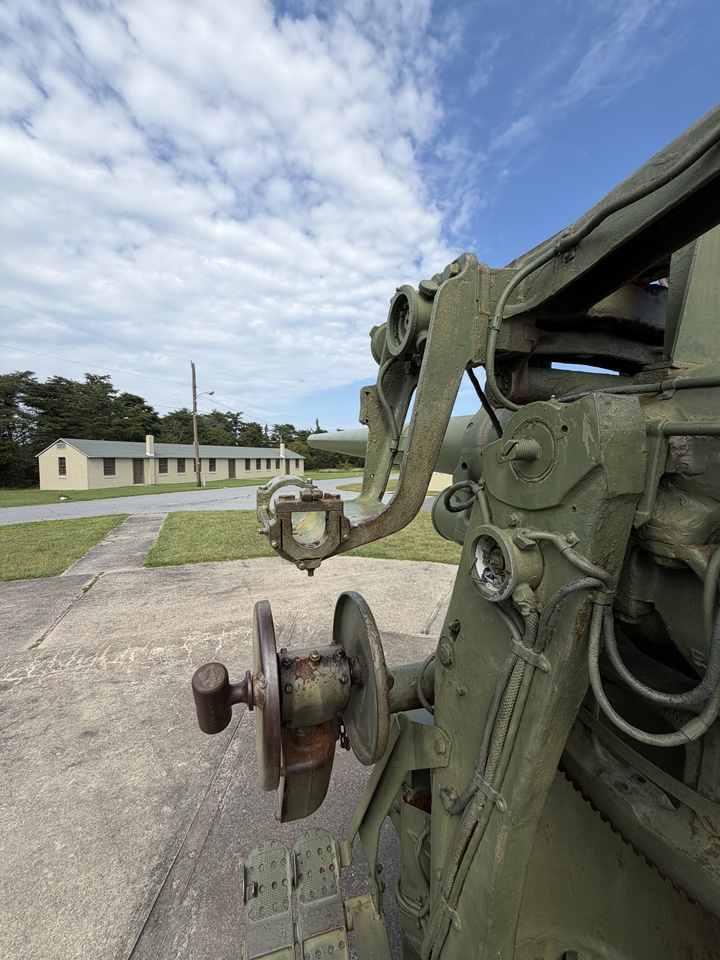
The parking lot at Cape Henlopen sits on top of a gun battery.
Not near one. On one. The bathhouse, the trails, the beach where families set up for the day — the whole recreational surface of Delaware's most-visited state park is laid over the remains of a coastal fortress that was built, in a hurry, because the United States government believed the Atlantic might arrive.
Most people who go there know there are towers. Fewer know what the towers were part of. Fewer still know that the last shot of the war in these waters was not fired at all — it was a surrender, in Delaware Bay, on the fourteenth of May 1945.
What was up the river
Start with the question the fort answers, because without it none of the concrete makes sense.
Delaware Bay is not, in itself, a strategic prize. It is the door to one. Behind that door sits the Delaware River corridor, and in 1941 that corridor was one of the most concentrated industrial assets in the United States: the Philadelphia Naval Shipyard, along with the refining and manufacturing capacity strung along the river through Delaware and New Jersey.
An enemy that could reach up that river, or simply close its mouth, would not be raiding a beach. It would be reaching into American war production.
So the defensive problem was never Cape Henlopen. Cape Henlopen was the position from which you solved a problem located sixty miles upstream. The fort exists on that headland for the same reason a lock sits at the entrance of a canal.
Building a town on the dunes
Money for a fort at the cape had been approved as early as 1934. Nothing much happened until Germany overran Western Europe in 1940, and then everything happened at once. Fort Miles was built between roughly 1941 and 1944.
At its peak it housed on the order of 2,500 soldiers and civilian personnel.
That figure is worth pausing on, because it changes the mental picture. This was not a gun emplacement with a guard. It was a small town on a sandspit — barracks, mess halls, power, water, roads, a hospital function, the daily administration of thousands of people — dropped onto dunes that had held almost nothing.
The armament was arranged in layers rather than a single line. Battery Smith carried two 16-inch guns. Battery 519, begun in November 1942 and turned over to the Coast Artillery in early 1944, carried two 12-inch. Batteries Herring and Hunter carried 6-inch guns; a mobile battery carried 155mm. In total the harbour defences ran to around a dozen batteries, layered from anti-aircraft through secondary and railway guns up to the primary armament.
The logic of the layering is simple enough: the big guns for a capital ship standing off, the medium guns for anything that got closer, the light and mobile guns for whatever came after that.
The eyes, and a number worth correcting
All of that armament had the same problem, which is that a gun at sea level cannot see far enough to use its own range. The answer was the concrete observation towers, and this publication has written about how they worked in The Towers on the Dunes.
What is worth adding here is the scale of the system, because it clears up a confusion that dogs the towers story.
Fifteen concrete fire control towers were built for these defences — eleven along Delaware's Atlantic coastline and four across Delaware Bay in New Jersey — supported by five steel towers along the bay itself.
That single sentence resolves the arithmetic that makes people argue. Delaware has eleven concrete towers. The system had fifteen. Both numbers are correct, they are counting different things, and the popular claim that Delaware retains "all" of some total is comparing a state count against a two-state system. The towers were never only Delaware's.
The war that actually turned up
Fort Miles was built to stop a surface fleet. A surface fleet never came.
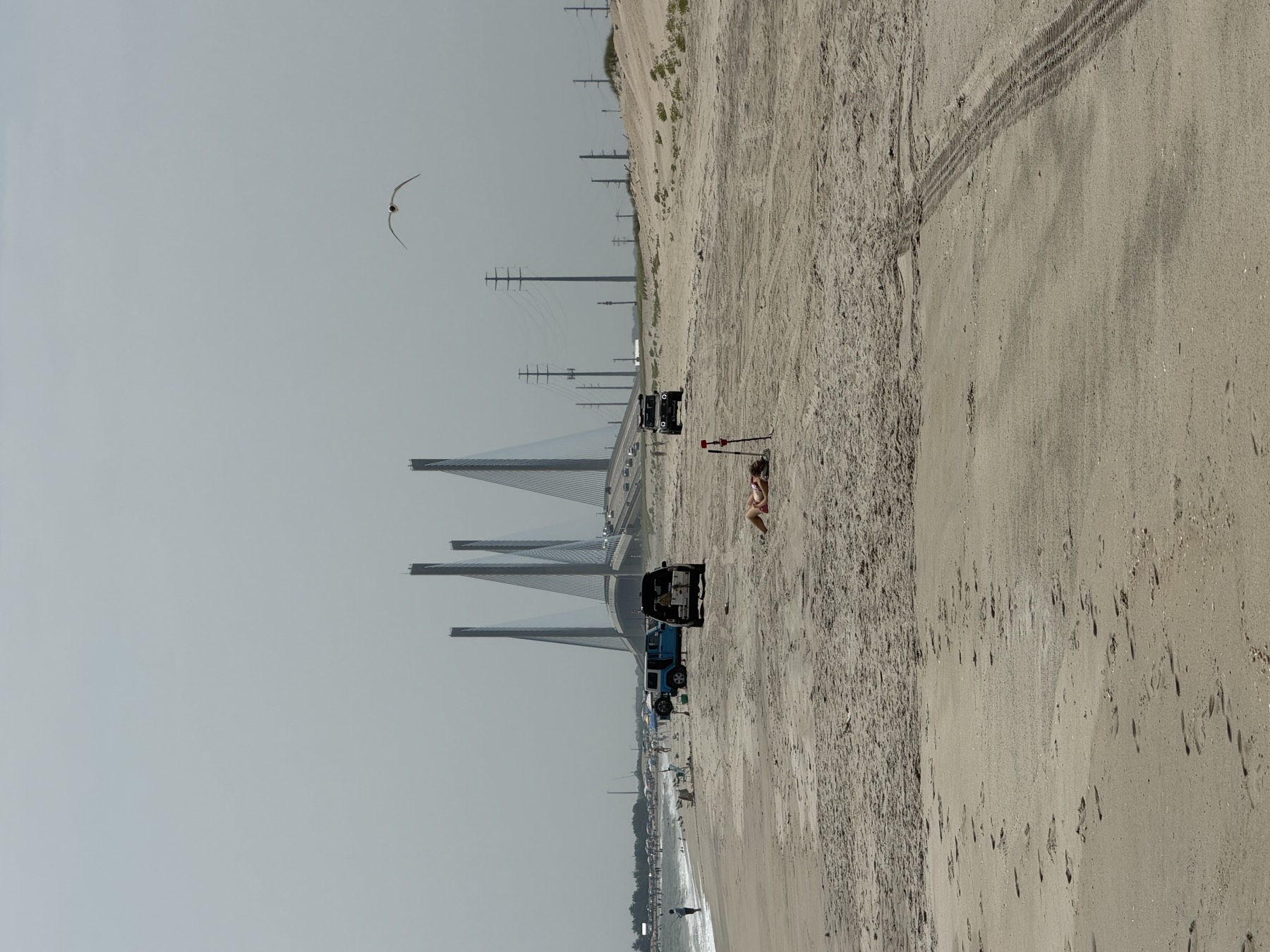
What came instead was submarines. In the first half of 1942, German U-boats operated along the American East Coast with a freedom that is genuinely shocking in retrospect, and the approaches to Delaware Bay were not exempt. They laid mines. They torpedoed shipping.
The specific loss worth naming: the tug John R. Williams went down off the entrance to the bay's Harbor of Refuge in June 1942, with fourteen men killed.
That is what the war at Cape Henlopen actually looked like. Not a battleship on the horizon in the crosshairs of a 16-inch gun, but a mine, a working boat, and fourteen dead within sight of a beach where people now put up umbrellas.
It is also why the enormous batteries can feel, in hindsight, like an answer to the wrong question. They were not useless — a defended harbour entrance is a harbour a surface raider does not attempt, and deterrence leaves no wreckage to point at. But the guns at Cape Henlopen never fired on an enemy ship, and the threat that killed people here was one they could not shoot at.
May 14, 1945
The most extraordinary thing that ever happened at Fort Miles happened after the fighting stopped.
Germany capitulated in early May 1945. On the tenth, the Type IXC submarine U-858, under Kapitänleutnant Thilo Bode, began surrender procedures at sea off New England. American escort vessels — USS Pillsbury and USS Pope — took control, put a US Navy crew aboard and removed much of the German crew.
On May 14 the submarine was brought in and delivered at Lewes, Delaware, with sixty-one officers and men.
By the US Navy's own account this was the first enemy warship to surrender in United States waters since the War of 1812.
There is a quiet irony in it that is hard to improve on. Fort Miles spent four years watching the Atlantic for a German warship. The one that finally arrived came in flying a surrender signal, under American guard, and tied up in the bay the fort had been built to close. U-858 had sunk nothing. It was scuttled off New England in 1947.
What happened to all of it
The harbour defences were inactivated in March 1946, and the entire category went obsolete almost immediately — radar, aircraft and missiles between them ended fixed coastal artillery as a serious idea.
The guns went. The concrete did not, because reinforced concrete built to survive naval gunfire is expensive to remove and nobody urgently needed the land.
Delaware formally accepted the former Fort Miles property as Cape Henlopen State Park in October 1964. Further parcels, including the fort's core, came across to the state parks later, and in the 2000s Battery 519 was opened as the Fort Miles Museum — you can now walk into the twelve-inch battery under the dune.
So the sequence runs: empty dunes, fortress, obsolescence, park. Roughly eighty years of recreation laid over roughly five years of emergency.
How to read the landscape now
Once you know it is there, Cape Henlopen stops being a beach with some concrete on it.
The high ground is not entirely natural. Battery mounds were built up and then planted and left to the dune grass, and the park's topography still carries the shape of what was buried in it. The towers are not scattered at random; they sit where the geometry required them to sit. The roads follow military alignments. The straight edges in the vegetation are where something was.
And the view is the point. The reason people drive out to the Point for the view is exactly the reason the Army built there: it is the place from which you can see furthest out to sea, at the corner where the Atlantic meets the bay.
The families and the artillery officers were looking at the same water for opposite reasons.
Sources: Fort Miles Museum / Fort Miles Historical Association history of the fort, for construction dates, personnel numbers, battery armament and the count of fire control towers; Delaware State Parks for the Fort Miles historic area and Battery 519; U.S. Naval History and Heritage Command for the surrender of U-858 on 14 May 1945 and its status as the first enemy warship to surrender in US waters since the War of 1812; contemporary and reference accounts of Battery 519's construction dates and the October 1964 acceptance of the property as Cape Henlopen State Park. Battery 519 mounted 12-inch guns; the 16-inch guns were at Battery Smith, and the two are frequently confused. Accounts differ on the exact sequence and dates by which individual parcels passed from federal to state control, and that transfer is described here in outline. The loss of the tug John R. Williams off the Harbor of Refuge in June 1942 with fourteen dead is given as reported by the fort's own historical account. Deterrence claims are inherently unprovable and are described as such rather than asserted.